Reflections on the Movie “Multiple Choice”

These are the ideas that surfaced for me while watching the film and during the panel discussion afterward. The screening was hosted at Hawai’i School for Girls at La Pietra on Feb 12 2026. I’m sharing them here in a more organized, readable form—still “notes,” but with a clearer organization (with help from chatGPT). My original hand scratch is at the bottom for reference!

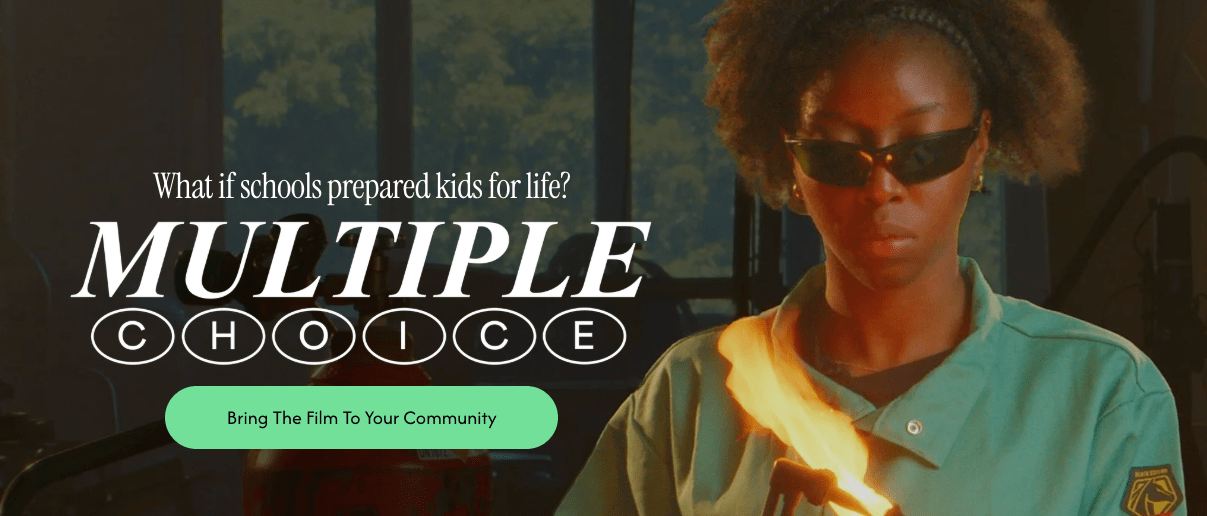
screen shot of movie page

1) The gap between CTE academies and core academics is real—and structural

In many high schools I’ve worked with, CTE academies exist, but CTE teachers and core subject-area teachers rarely intersect in meaningful ways. Meanwhile, core teachers—especially in math, ELA, and sometimes science—are pulled toward accountability systems that privilege what’s easily measured on standardized assessments.

The result is predictable: academies do their “own work,” core classes do their “own work,” and the possibility of truly integrated learning gets squeezed out by the pressures of test preparation.

What I appreciated about the film is that it hinted at a different definition of success—one where student products and performances could serve as evidence of learning if they’re aligned with the academic outcomes we care about. The problem is that this kind of learning is rarely what gets reported publicly, and it doesn’t “count” in the same way high-stakes test data does.

This also made me think about Big Picture Learning, which tackles the “real-world learning + academic learning” connection differently by designing community-based learning as a daily expectation rather than an add-on.

2) Teacher readiness is a make-or-break variable

A model like the one highlighted in the film raises a question we often avoid because it’s uncomfortable: what qualities, dispositions, and competencies do teachers need for integrated learning to work well?

This is the same challenge High Tech High has wrestled with for years: shifting teachers from transmitters of content to designers and facilitators of integrated learning demands a kind of professionalism that not every teacher is prepared for—or even willing to embrace. Many teachers love their subject as they learned it, and understandably want to teach it that way.

So part of the work isn’t just “change the schedule” or “add projects.” It’s adult learning. This is the work we grapple with daily at Kupu Hou Academy – as do other great orgs like PBLWorks and High Tech High GSE

3) We keep teaching what’s easiest to test

One of the lines that stayed with me (and that Ted Dintersmith often comes back to) is the blunt reality: schools tend to teach what’s easiest to test.
And what’s easiest to test often lives at the lower levels of thinking and is detached from real application.

If we want to implement integrated, real-world learning at scale, we have to confront that mismatch head-on—because the current system pushes schools toward “coverage” and away from meaning. As my mentor Larry Dukerich said 30 years ago – “to cover means to obscure from view”

4) This is really a “purpose of school” conversation

This brought me back to a long-running question: What is the purpose of school?
And if we say “preparing students for life,” then we have to be serious about what outcomes we value.

I found myself thinking about former NAIS Director Pat Bassett and his broader argument that meaningful change requires rewriting the canon of what we believe school is for.

Frameworks like the Hewlett Foundation competencies help here because they broaden the target: academic readiness, yes, but also collaboration, communication, critical thinking, learning how to learn, and academic mindsets.

But there’s a push-pull dynamic:
If public measures stay narrow, schools feel pressure to stay narrow.
If we expand what “counts,” schools have more permission—and incentive—to build models like the one in the film.

5) “Good at school” vs. “good at life”

Another line that hit hard: we’re often teaching kids to be good at school, not good at life.
And many adults who succeeded in traditional schooling understandably reinforce that model—because it worked for them.

So the question isn’t just instructional. It’s cultural:
How do we help communities re-imagine what “rigor” looks like?
What does “success” look like in Math, ELA, Science, etc., when the end goal is life-readiness, not test-readiness?

6) The future exists—it’s just not connected (or evenly distributed)

A variation of that familiar idea kept coming up: we already know strong models exist, but they aren’t connected or amplified enough to create public pressure for widespread change.

We have “pockets of the future,” but they don’t yet generate the kind of collective momentum that forces the system to shift.

7) A sobering thought experiment about relevance

I had a strong “wondering” during the discussion:

If we made a checklist of everything students are assessed on K–12, then asked adults—at different stages of life and across different careers—which items truly mattered for work and life, I suspect we’d be stunned by how much of the assessed curriculum had little lasting value.

That doesn’t mean knowledge doesn’t matter. It means we should be more honest about which knowledge is essential, when, and why.

8) Joy, engagement, and the stubborn myth about rigor

The students in the film genuinely enjoy school. And that immediately made me think of Pasi Sahlberg and his arguments about play, joy, and healthy development (including ideas commonly associated with his book Let the Children Play).

There’s still a deeply rooted belief in the broader culture:

If students are enjoying learning, it must not be rigorous.

But we know that’s backwards. Flow, challenge, purpose, and authentic work can be deeply demanding—and deeply satisfying.

So again, back to purpose: if school is about preparing students for life, what conditions do we need to create so students can develop capability and meaning? And find joy in it?

9) Why does the system resist change so reliably?

As the panel reflected on how long these efforts have been underway—decades, in many cases (a century if you go back to John Dewey)—I kept returning to the forces that pull innovation back to the status quo.

Some of it is organizational inertia: the way schedules, departments, and institutional routines create “gravity.” I found myself thinking about Clay Christensen (Innovators Dilemma) and the dynamics that make disruption hard inside established systems.

And some of it is financial and structural pressure—particularly from institutions like the College Board and the broader ecosystem of high-status signals that schools feel compelled to optimize for.

10) Mindset and structure: are we building fixed mindsets by design?

Finally, I was wondering about Carol Dweck’s research on Mindset and whether traditional school structures inadvertently reinforce fixed mindset patterns.

When learning is tightly controlled—bell schedules, age grouping, narrow pacing, constant ranking—it’s not hard to imagine how students internalize messages about ability, compliance, and performance.

In contrast, a more progressive structure—where time is used differently, learning is integrated, and students do authentic work—may be more likely to cultivate growth mindset, agency, and self-direction.

That aligns with what we saw in the film: students who seemed to know how to learn, how to chart a future, and how to be contributing members of their communities.

** If you want to arrange a screening of the Movie, you can see the trailer here and request a showing, or just reach out to colleague, friend and deeper learning evangelist Josh Reppun at josh@reppun.com**

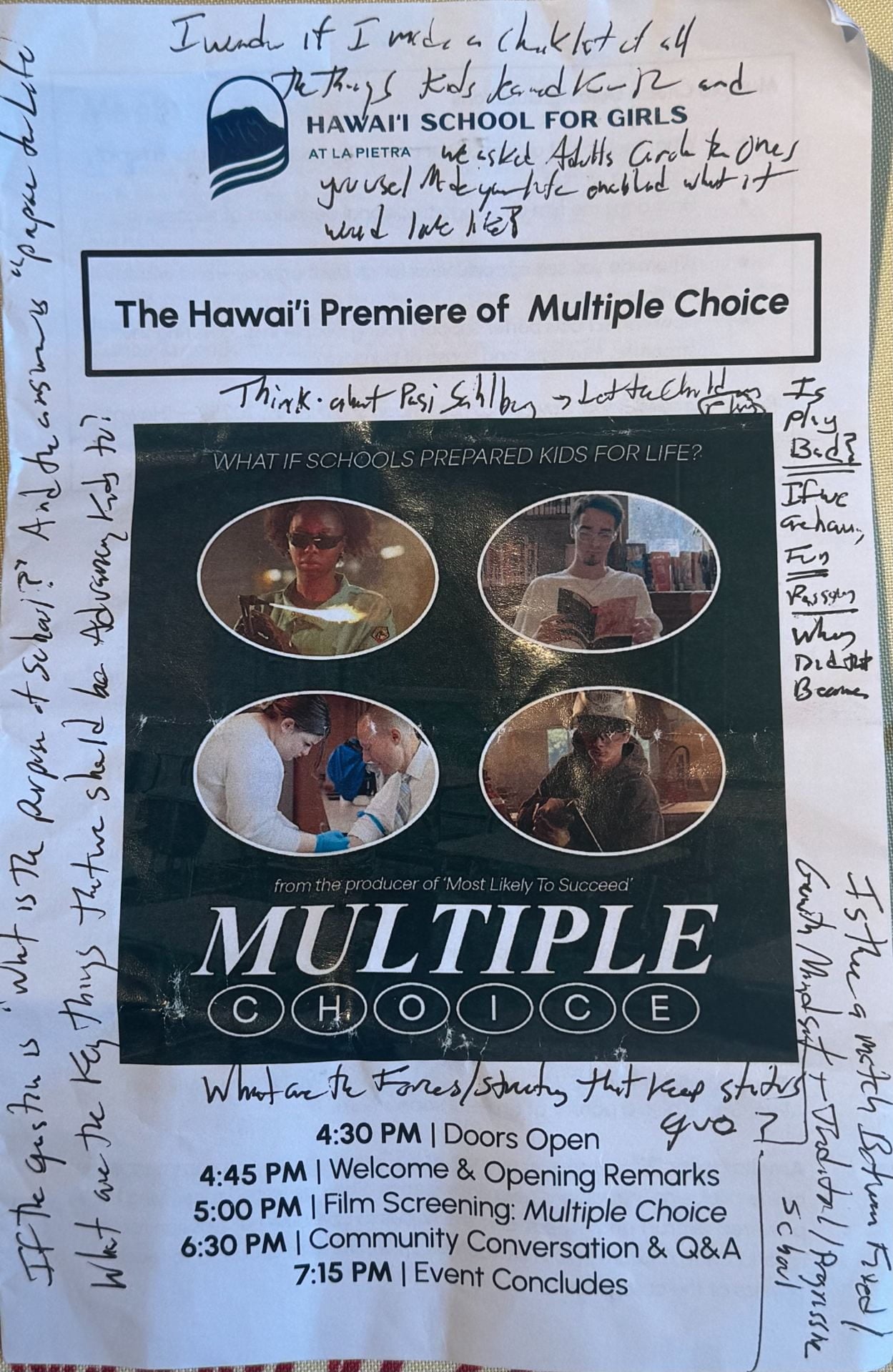
my notes taken during the event

From Compliance to Dignity: Lessons from Learning Forward 2025

Learning Forward Banner


The week of December 7, Kaile and I attended the national Learning Forward Conference in Boston, Massachusetts. While the weather was a reminder that we were far from Hawaiʻi, the conversations were anything but cold. Across three days, a set of powerful through-lines emerged—about leadership, systems, voice, and what it really means to keep learning centered on students in uncertain times.

Cornelius Minor


The conference opened Monday morning with a keynote from Cornelius Minor, Keeping the Focus on Kids in Uncertain Times. Minor grounded the week in a moral imperative: when systems feel stressed or unstable, the temptation is to retreat into control and compliance, but our responsibility is to double down on relationships, humanity, and care. His message was a steady reminder that equity work begins with how we see children—and whether our decisions consistently reflect that focus.

national coalition for improvement in education logo


That idea of systems shaping experience carried directly into our Monday morning session with our friends at the High Tech High Graduate School of Education team, Process Mapping Your Way to Better Systems, which drew on work from the National Coalition for Improving Education. Rather than treating dysfunction as a people problem, the session invited us to look closely at processes—how work actually moves through a system, where friction shows up, and how well-intentioned structures can quietly undermine learning. It reinforced a recurring theme of the week: experience is the system. During the session, I spent time reflecting more deeply on our process for coaching calls with teams of teachers. Time well spent!

Monday afternoon’s workshop, “Core, Contingency, and Paradox: Leading Systems for Continuous Improvement,” by Jal Mehta reframed school improvement as human, not technical, work. Drawing on complexity science and Margaret Wheatley’s Six Circle Model, he emphasized that sustainable change requires attention both above and below the “green line.” Structure, process, and strategy matter, but relationships, identity, trust, and shared meaning are what allow improvement to take root. Mehta challenged leaders to match approaches to the type of problem they face and to live within productive tensions—action and reflection, order and emergence. Improvement, he argued, is less about control and more about learning our way forward.

Shane Safir and Sawsan Jaber

Tuesday morning began with the keynote Pedagogy of Voice: Street Data and the Path to Student Agency from Shane Safir and Sawsan Jaber. Their work reframed data as something gathered through listening rather than extracted through dashboards. Student voice, they argued, is not feedback—it is access to power, belonging, and authorship. Crucially, they emphasized symmetry: if we want agency for students, adults must experience it as well.

Logo for HTHGSE

That notion of symmetry carried into Tuesday morning’s session, Leading for Deeper Learning, led by Melissa Daniels and Stacy Lopez from High Tech High GSE. They challenged leaders to examine whether adult learning truly mirrors the inquiry, collaboration, and reflection we value for students. School culture, they reminded us, is shaped less by vision statements and more by the daily experiences people are invited into.

Image of front of Princess Ke’elokalani Middle

Tuesday afternoon brought us closer to home with Transform Your School Through Collective Action, led by Joe Passino, principal of Princess Keʻelikōlani Middle School in Honolulu, and Bette Moreno. We were proud to hear how their leadership moves—high expectations paired with high support, visible collaboration, and shared responsibility—are shaping student commitment and learning. Their work made clear that transformation is not driven by heroics, but by culture built collectively over time.

Wednesday morning, we closed our conference experience by facilitating our own session on AI for Equity and Deeper Learning. Rather than positioning AI as the work itself, we framed it as a mirror—one that reveals values, assumptions, and design choices. The thoughtful engagement of participants suggested the field is ready to approach AI with discipline and purpose, not hype.

I left Boston encouraged. Across sessions, the message was consistent: deeper learning emerges when we align systems, culture, and leadership around humanity, voice, and agency—for students and adults alike.

Let AI Be Hobbes, Not a Hall Monitor

Image credit: Bill Watterson

As we navigate the growing presence of AI in education, I keep coming back to the comic strip Calvin and Hobbes. In particular, the way Hobbes never handed Calvin the answer—he leapt into the cardboard box with him, launching toward Saturn, getting lost, making meaning. That’s the spirit I hope we hold onto as we consider how AI might walk with us rather than think for us. Here’s a reflection on curiosity, imagination, and the kind of company we choose on the learning journey.

“Learning isn’t about knowing the path—it’s about building the courage to walk it, with just enough company to keep you wondering.”

There’s a Calvin and Hobbes strip that’s always stuck with me. Calvin raises his hand in class and asks, “May I be excused, please? I need to go bad?” The teacher says yes. Next frame, he’s walking into his house, and his mom’s staring at him, bewildered. “What are you doing home?” she asks. “I had to go,” Calvin says.

Screenshot

It’s perfect. Calvin’s imagination couldn’t be contained by classroom norms. When the structure didn’t speak to his curiosity, he left—and we laugh, because deep down we get it. There’s a wildness in learning that systems too often try to tame. And no one gets that better than Hobbes, Calvin’s tiger co-pilot, who doesn’t hand him answers but pushes him to explore every cardboard-box idea he dreams up.

Lately, I’ve been wondering: what if AI could be more like Hobbes?

That question hit me as Alex Hutchinson explain his new book “ The Explorer’s Gene”, where he talks about the human drive to explore, to wander, to not know what’s around the next corner. He and David Epstein dig into how our brains and bodies are wired for exploration—and how much we lose when we optimize too soon, or choose comfort over curiosity.

And then I read Ethan Mollick’s post The Cybernetic Teammate. He makes a compelling case that the best uses of AI don’t replace people—they expand them. AI, in his view, isn’t a faster calculator or a clever shortcut. It’s a teammate. One that nudges, reflects, and helps you think in broader, more interdisciplinary ways. In other words…a Hobbes.

But here’s the danger: If we bring AI into schools and workplaces without that Hobbes-like spirit, we risk shrinking the very range of human exploration. We’re already doing it. We’ve gone from kids roaming six miles from home to barely 300 yards. And that same constriction is happening intellectually—when we rush students through hard questions, when we Google instead of grappling, when we mistake speed for insight.

In my own teaching, I didn’t always have the courage to admit I didn’t know something. But over time, I learned to model curiosity instead of certainty. Teaching electronics, for instance, we’d run into things I didn’t fully understand. Instead of bluffing, I’d sit beside students and say, “Let’s figure it out.” We’d poke at the black box—literally and metaphorically—and uncover the systems beneath. That, to me, is real learning: not having the answers, but being willing to stay in the question.

And that’s how I’ve come to see the potential of AI—especially when it’s designed and used with intention. Right now, in this creating this post, , I did not ask AI to give me something. I used it to stretch my own thinking. To reflect, wonder, and wander. And it worked—not because it’s efficient, but because it’s relational. It’s walking with me.

If we want AI to support human growth, not replace it, we need to treat it less like a productivity tool and more like a thoughtful co-learner. We have to trust that students—and adults—will do the hard thinking when they’re given something worth thinking about. We need to design learning not around shortcuts, but around meaning. That’s the promise. And the risk.

Because in the end, learning isn’t about knowing the path—it’s about building the courage to walk it, with just enough company to keep you wondering.

So maybe it’s not about the journey or the destination.

Maybe it’s the company.

And the best kind of company doesn’t do the walking for you. It walks beside you—like Hobbes—laughing, nudging, imagining, and daring you to explore.

Image credit: Bill Watterson

Just do it!

from Getty Images


As we approach the end of another school year, teachers look forward to a few precious weeks of summer to reflect, recuperate, and prepare for the upcoming fall. This period is an excellent time to consider how our students learn and, even more importantly, how our teachers grow in their practice. For those of us who advocate for deeper learning, it’s clear that there are structural issues with how teachers develop professionally and how adolescents are taught in schools.

The problem partly stems from a long history of schools being designed around a “Tell, Show, Do” approach. While there’s nothing inherently wrong with this method, it often creates a gap between telling, showing, and doing. As a former Boy Scout assistant scoutmaster, I’ve seen firsthand how skills like using a knife, administering first aid, or leading a group are taught using this approach. However, the challenge lies in the delay between the different stages of learning.

Consider learning to ride a bicycle. We wouldn’t spend years teaching about all the parts, testing for understanding, and separating components like wheels and pedals from balance. We certainly wouldn’t wait long between showing and letting the learner practice. Yet, in both teaching and student learning, we often focus extensively on individual parts without letting them play the whole game. The line “when do we use this information?” has been part of the student voice for a long time. Historically, learning happened through mentorship and apprenticeship, where learners worked alongside experts, observed, listened, and practiced actual skills incrementally.

In his book “Learning to Leave,” Elliott Washor argues that effective learning involves dovetailing, doing, showing, and telling in incremental steps without delaying practice. This concept is crucial as we help teachers integrate deeper learning into their work. Providing opportunities for them to practice is essential.

In an article about microcosms of practice, Jal Mehta advocates for teachers starting with a unit (a microcosm) to experiment with pedagogical and assessment practices in deeper learning, whether it’s project-based learning, inquiry, place-based learning, design thinking, or other student-centered approaches.

This leads to the central idea of this article: if we truly learn best by doing, how do we ensure that this happens in our professional learning? One approach is providing teachers with opportunities to practice their new skills in the classroom. This summer, we will work with a group of teachers from Nānāikapono Elementary, introducing them to deeper learning design concepts and then observing, sharing, and building on what works during their four-week summer program. This summer lab approach offers a rich opportunity to just do it, with support and opportunities to learn from and refine practices that enhance engagement, evidence collection, and learning in their classrooms. As Dewey said “we don’t learn from experience, we learn from reflecting on experience.”

Research shows that experience increases teachers’ effectiveness and efficacy. One of our biggest challenges is giving teachers the chance to not just be told or shown new teaching methods but to put them into practice. It’s time to just do it!

AI generated – “PBL educator saying Just do it”

AI in Education: Navigating the Waters of Deeper Learning – Truly Living in Permanent White Water

“A female Polynesian teacher swept up in white water using her desk to navigate through looking confident” prompt, Mid-Journey, Discord Server 13 Aug. 2023,

“A female Polynesian teacher swept up in white water using her desk to navigate through looking confident” prompt, Mid-Journey, Discord Server 13 Aug. 2023,

The term “Permanent White Water” comes from Peter Vail’s “Learning as a Way of Being (1996) and has always been a powerful metaphor for ongoing change, and never more true than at this moment.

Navigating The White Water with Deeper Learning

Much like the waters of the Hawaiian Islands, deeper learning comprises moments of turbulence, tidal pulls, following seas, and sweet rides on waves – if you can catch them! It’s about reading the water, grappling with real-world challenges, and emerging with an enduring understanding. In our journey at Kupu Hou Academy, we’ve always emphasized the importance of being present, of truly immersing oneself in the learning experience, whether it’s understanding the complex interdependence of our local water systems or the intricacies of a mathematical concept. At its core, deeper learning, as described by Mehta and Fine in the book “In Search of Deeper Learning” revolves around the pillars of “Identity, Mastery, and Creativity.” It’s not just about acquiring knowledge; it’s about forging a strong sense of self, mastering complex skills, and channeling that mastery into creative endeavors. It is this kind of learning that makes knowledge powerful, transferable and engaging.

AI: The New Current

Enter AI. This technological marvel promises to revolutionize education and be disruptive to entrenched systems and past methodologies and beliefs about teaching and learning. As champions of student-centered learning, how does it fit into our deeper learning framework? Can it enhance the richness of our learning experiences, or will it merely streamline them, potentially robbing us of the ‘grappling’ essential to true understanding?

Imagine a classroom where AI-driven platforms adapt to each student’s learning style, providing real-time feedback and challenges tailored to their current understanding. It’s not about making the journey smooth; it’s about ensuring it is meaningful and aligned with the learner’s “just right” feedback and support.

The Confluence of Culture and Technology

Drawing from our experiences, like the insights gained from indigenous perspectives managing and appreciating water, it’s essential to approach AI with a balanced view. Technology, when integrated with cultural and local contexts, can provide a richer, more holistic learning experience. The stories, the narratives, the connections – they all matter. And AI when used as an adaptive tool can help weave these threads together, creating a tapestry of learning that’s both deep and wide.

Charting the Course Ahead

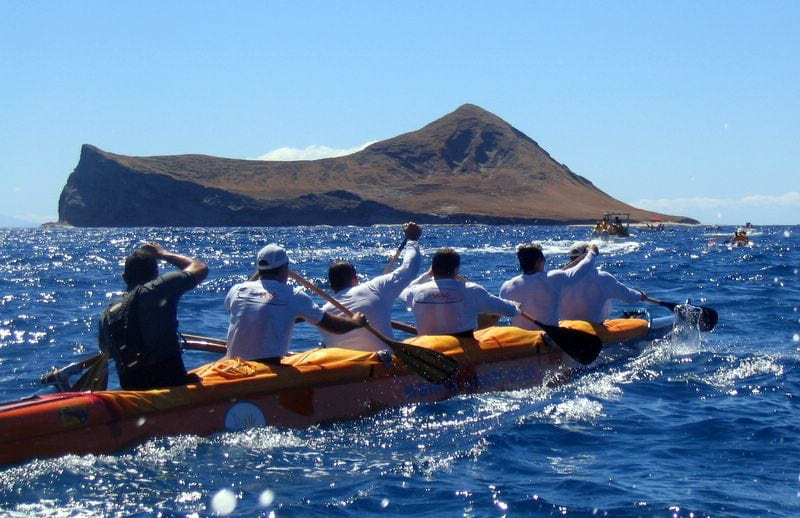
As we navigate these turbulent waters, it’s crucial to have a clear sense of where we are going. Much like the attached picture (that’s Mark steering a crew off Manana Island near Sandy Beach on Oahu) we need to read the waters we are in AND have a commitment to the ultimate destination we are heading to. Just as we have supported hundred of teachers over the past years in developing meaningful projects and inquiries for their learners, integrating AI into education requires clear goals (Got a good Essential Question?), purposeful learning, assessment criteria, and continuous feedback. We need to ensure that our students not only reach their destination but also cherish the journey.

The fusion of AI with deeper learning presents both challenges and opportunities. As educators, it’s our responsibility to ensure that we harness the potential of AI while staying true to the principles of deeper learning. The journey promises to be exciting, and I invite all educators, students, and tech enthusiasts to join us as we chart this new course.

**This draft was supported by conversations with ChatGPT on August 13, 2023

Reference:
Vaill, Peter B. Learning as a Way of Being: Strategies for Survival in a World of Permanent White Water, San Francisco: Jossey-Bass, 1996.

Mehta, Jal, and Sarah Fine. In Search of Deeper Learning: The Quest to Remake the American High School. Cambridge, MA: Harvard University Press, 2016.

Reflections on Water and Wailele

(This post a reflection from a class visit from our Kumu (Teacher) Makana Kane Kuahiwinui, who spoke to us about the Hawaiian cultural perspective on water, in general and specifically in our Manoa Valley.)

The work we have been doing and thinking about water consumption at times seem disconnected from a real problem, situation and solution. Kumu’s sharing today broadened my thinking because I usually see most things through a western science perspective. Is it dirty? How do we know? How can we clean it? I deepened that meaning by really backing up and considering what the water all around, the rain (Tuahine) we see every day, the running water on campus, Wailele and how it sits with Kahala O Puna in the middle of campus. I need to recommit myself to not just going for learning information but learning to be present in this moment and know why and how it matters.
The connection to this place in Manoa is something that we can do something about if that speaks to us. The importance of how water is around us and why and what we could do with it is a lesson and a challenge. And an opportunity.

I also think that the idea of ‘amakua and the importance of Pueo is interesting. The fact that Hawaiian culture speaks of the importance of a generational tie to what might be our guardian’s ties to families and their histories binds us together to this land.

Lastly I am struck by the importance of story. The value of connecting events, places, people through a compelling narrative is a uniquely human characteristic. I can do better job of using stories as a means to conveying ideas, values, concepts, etc. I should find more storytellers to help engage and tie together our work… Who might this be?
What was my wish for Wailele? That I don’t go by without checking in on her and asking how we are doing with her. We, our students, can visit and ask “how are you doing, how are WE doing?”

Three Kinds of Math?

Money, Philosophical and Artisanal Math

There was a wonderful piece on National Public Radio this week that told the story of Harvard researcher Houman Harouni (https://www.gse.harvard.edu/faculty/houman-harouni), who had done historical research on why we learn mathematics the way we do.

(His full dissertation is here: https://dash.harvard.edu/bitstream/handle/1/16461047/HAROUNI-DISSERTATION-2015.pdf?sequence=1)

In the dissertation, he gives a very specific example of how this kind of approach to mathematics can be viewed through three different approaches.

Money Math
He makes the case that all of western mathematics has ended up looking like problems of this type:

Susan has 12 oranges. Her mother gives her 15 more. How many oranges
does she have now?

or: 12+15 = ?

This kind of mathematics came out of the economics of the time – money counters and accountants, business people needed to know this kind of math in order to balance the books. He makes the compelling case that the economies drove the need for this kind of math to be necessary, and it became the predominant way of thinking of mathematics since the Renaissance.

Philosophical Math
He offers two other types of mathematical approaches. What if the problem was worded this way:

27 = ?

This approach is a more philosophical approach about the nature of the number, and the ways that it might come to be and what it represents.what could go into the right side of that equation? 9×3? Three cubed? Log base three of 27? It invites a very different kind of mathematical thinking and exploration.

Artisanal Math
Another approach would embed the math in the professional work during apprenticeships with craftsmen. This was very reminiscent of the work of Jean Lave (http://www.ischool.berkeley.edu/people/faculty/jeanlave) and her excellent work on situated learning. In studying the traditions of apprenticeship for Tailor’s in countries like Tunisia, it was clear that mathematical learning was built into the apprenticeship, but it is not anything like what we would call traditional teaching and learning of mathematics. Moreover, these tailors had a high functional ability to work with mathematics that were specific to their craft.

Tying it all together
Over the past six years in working in our MPX program I have been delighted and challenged to try and build all three kinds of mathematical approaches into the work we do with our projects. We have developed mathematical models in our scientific community to understand and categorize physical phenomena, we’ve looked at form and function in ways that they express themselves in artistic work in design and engineering, and we’ve practiced traditional math as a means to understand some of the ways that procedural knowledge in mathematics can help us unpack what we see behind certain expressions. I think the real challenge of the evolution of mathematics education needs to be in rethinking how do we approach these sometimes complementary but more often than not this connected or even underutilized approaches to building mathematical understanding in all of our students. In some ways, they fit the three legs of mathematical understanding that are part of common core: no (money math), do (artisan old math), understand (philosophical math).

Here is the NPR story that explains some of the research: