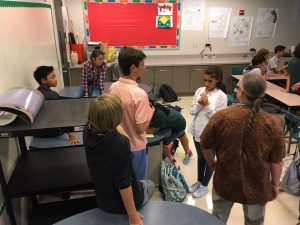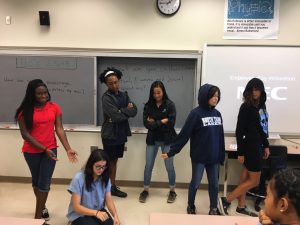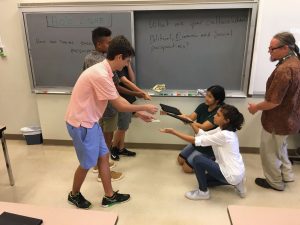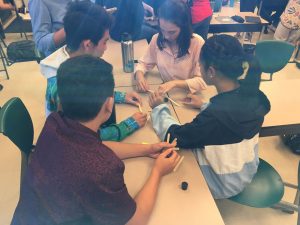
One of the challenges in secondary mathematical education is finding the space between computation and thinking. Often times, the mathematical work we do in traditional math classes centers around solving particular kinds of mathematical algorithms. Most of us remember learning how to do a two column proof, learning how to factor a polynomial, or finding the slope of the line. The famous question “when are we ever got a use this stuff?” is not just a trivial query in the part of our students, but a legitimate question about the applicability of the procedural math we learn and is considered an important part of our math scope and sequence. Algebra, geometry, advanced algebra, statistics, precalculus, calculus… The sequence of math has its own inherent hierarchy and one of the challenges is on a day-to-day basis finding meaningful ways to give students opportunities to practice and apply this knowledge in useful ways. We know from research, that the more we can anchor this in real experiences, the mathematics will be tied to more than just a series of rote steps, but to actual principles of science, architecture, economics, population studies, etc.

In our MPX planning, we try and balance this sometimes mutually exclusive way of learning math – math rules, and math function. I have included a couple of examples that seem simple, but turn out to be more challenging than they might seem.

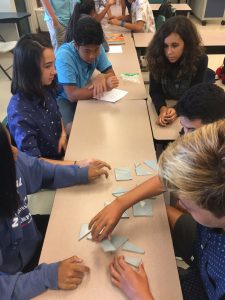
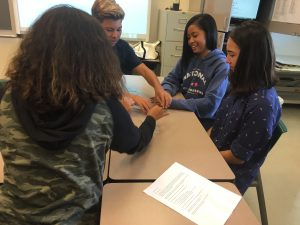
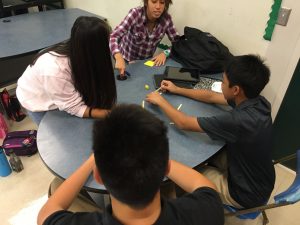
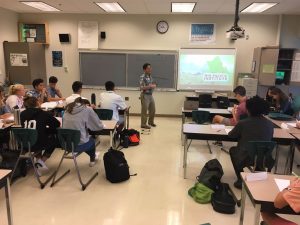
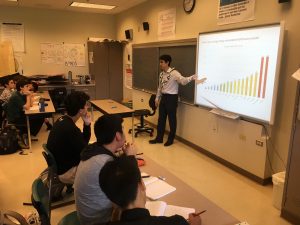
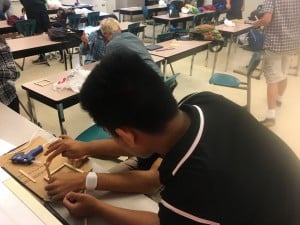
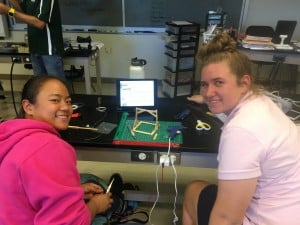
The first two graphics below are examples of students doing a cost analysis for the aquaponics project that they are building in our class. The main structure will be composed of plexiglass, and the measurements for the deconstructed shape need to be accurate, and understood as their individual deconstructed geometric shapes. One local manufacturer gave our students a pricing structure that was based both on the area ($15 per sq ft) of plexiglass needed, as well as the lineal foot measure ($2.50 per lineal ft) – the perimeters for the shapes. The challenge for our students was calculating the actual cost for materials and cutting for the shapes. As a result, they needed to apply their understanding of perimeter and area, as well as take into account ratio thinking about cost per item and doing an aggregate total for their object. As you can see, one group actually had an octagon is a part of their shape, which presented wonderful opportunity to look at area formulas for polygons.

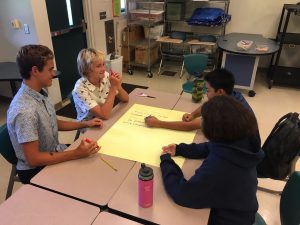
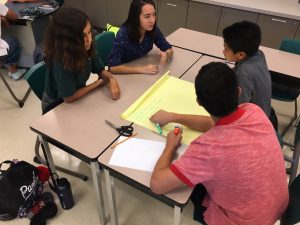
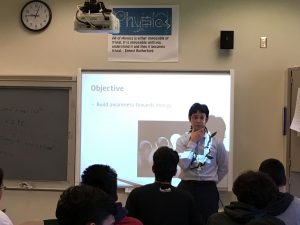
The next two pictures show another problem that came up which is a more traditional application mathematically, but still give students a chance to practice their thinking in a real scenario. Students were asked to calculate the height of a light pole in our Watase courtyard using their understanding of similar triangles, which we had done a more traditional math lesson on earlier in the week. Sometimes in our work, we do start with core concepts in geometry that we know must be covered, even if there isn’t a perfect fit to a project that we have – the ugly deal we need to make with the devil to both do original authentic work, and yet still cover the basic concepts in our geometry and biology series that are part of the ninth-grade experience.

So one of the challenges that we have is looking at any particular domain of knowledge in our geometry series and continually asking is there a way to backward map from one of our projects to this content. This is not always possible. The next possibility for us is to hopefully find something inherently interesting in a particular content sequence that we can map to. My favorite example of this is the one that mathematician Dan Meyer shows in his tent lecture below:

so where do these ideas come from? We often look through many different than textbooks, to see what kind of end of chapter problems (like Dan did) to find something that would be engaging, authentic, and serve the purpose of learning and reinforcing the concept correctly. Sometimes we can find these fairly easily (like the poll activity mentioned above) other times hours of searching for inherently interesting examples turn out fruitless. As we build a repertoire of activities, over the years we will probably have a more refined way to define, create and refine activities that are successful… But the search continues to try and find the match between authentic mathematical thinking, and learning the kind of computational skills that are inherent on standardized testing and expected at higher levels of mathematics coursework they may encounter. An ongoing challenge…

Wonderful world of water at Waihee Tunnel

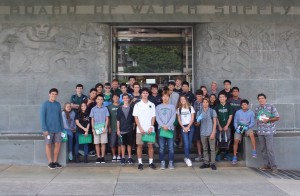
at the tunnel entry


On Friday, January 11 our MPX 10th grade students and teachers visited the Waihe’e Tunnel in Kahalu’u. As a precursor, we have spent the year investigating topics in sustainability; both with a worldview, but more particularly with a focus on our islands and our areas were we can make impact like on our campus Mid-Pacific Institute.

Our inquiry on this matter is focused around questions like:
How are resources distributed around the world and in the islands?

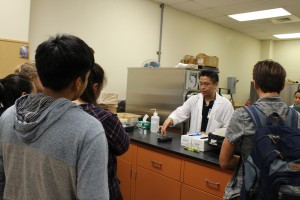
Mr Aiu explaining where the water collects in cracks


What kind of footprint do I leave in both using resources and disposing of waste?
What are some ways that I can become an advocate to reduce our use of resources?
What are ways that we use water in our lives and how can we measure and reduce this impact?

During the first semester, students were engaged in creating a water audit of our campus to better understand how we use water, in ways that they might be able to help in understanding what we use, and ways we might save.
This trip allowed us to see where the water comes from, and provides a unique opportunity in a isolated watershed to see how water makes its way from the aquifer to places like our campus and our homes. The tour itself starts by having students hike in over a mile (see photos)

hike into valley

before you reach the tunnel that was bored out of the mountain over 50 years ago. The tunnel itself is 1500 feet long and after walking with flashlights down it’s length, at the end of this there are two bulkheads behind which a large naturally forming compartment holds a column of water 52 feet high that is filtered down from rainwater from the mountain above.

mpx 10 in the tunnel

This compartment provides approximately 5,000,000 gallons of water a day primarily to the windward side of the island.
Our tour guide, Board of Water supply expert Arthur Aiu, spent almost 2 hours explaining where the water comes from, how we capture it, and why preserving this precious resource is critical for our sustainability on these islands.

Students will now be able to use this information as they consider ways in which they are behaviors and advocacy can make a difference for their future.

collecting water for drinking

I have been late (inexcusably so) in putting down the work that we’ve been doing here on a blog for our program called Mid-Pacific eXploratory. The program is explained here

My goal with this blog will really serve to document the day to day workings in our class, the higher level conversations about the challenges of implementing a program like this in an already existing independent school, higher-level thinking around why we would want to switch education to a more authentic framework, and other relevant aspects that fit in with our schools of the future initiative for HAIS and Kupu Hou at MPI.
Imua (onward!)
mark

I just came back from a 5 day teacher workshop at Hawaii Prep Academy in Waimea on the Big Island. The Summit was Titled “Hoku a ‘aina” (Stars and Land) and the theme was sustainability. Lots to share, as the workshop was excellent – really excellent! Hosted at the one of a kind LEED Platinum eLab at HPA (http://www.hpa.edu/academics/energy-lab) and organized by one of the smartest people I know, Dr Bill Wiecking (a polymath of the highest caliber), our group included 15 teachers from grades 1-12 at HPA, plus Alan Nakagawa (inquiry based learning specialist award winning teacher and administrator) and Mark Standley (incredible teacher, administrator, consultant and internationally respected digital storyteller http://www.mstandley.com/).

We had a keynote from Nainoa Thompson to start us off – the importance of both story and connecting to history got us off on an incredible journey. We teleconferenced with students and teachers in Alaska, West Virginia, North Carolina, Malaysia, England, amongst others. On Tuesday we visited state of the art facilities: Mauna Loa Atmospheric Observatory, Mauna Kea Observatories. On Wednesday we visited Natural Energy Labs Hawaii including stops at a solar plant that converts sun to heating mineral oil that generates MW of electricity, new generation PhotoVoltaic, Cellana: making BioFuel from Microalgae and Kona Blue – a fully functional fish farming operation. On Thursday we visited the 30 MW Puna Geothermal facility as well as the Jagger Museum at Hawaii Volcanoes National Park.

All of these presentations and visits were tied together with an essential question of how to deal with the coming issues worldwide of Water, Food, Energy and Culture. The teachers were challenged with thinking about how to include sustainability as a focused area of their curriculum – there was certainly great thoughts on that throughout the week.

To focus on one area, we talked a bit about the pending crisis in these areas and how to engage students about it without having them feel overwhelmed. We also talked extensively about the value of creating a new narrative to draw new attention to the problem and ways to the solution (kudos to Mark Standley for wrapping the excellent book Switch, which gives a lot of insight into ways to create change when it is difficult). I found myself thinking about the evidence from the Mauna Loa tests of CO2 that dated back from 1958 – the first real scientific data that something unprecedented was going on and I remembered the old James Burke series: After the Warming which was released in 1997. I used to show this to my students back then, because I felt there was not enough awareness of the pending issues.

I found the video on youtube:

(I actually re-watched it for the first time in a decade on my ipad, where it plays as a series of 11 10min clips).

If you have not seen it, it is worth a watching – essentially, he plays a reporter in 2050 who does a retrospective of how the Planetary Management Authority, established in 2000, saved us from our pending doom. Well here we are 11 years after that with still not enough political courage to do what is right for the planet – I think the dolphins were right to leave and thank us for the fish…(homage to Douglas Adams)

In watching it, a few things are obviously missed – the rapid rise of china’s economy, the lack of political will 15 YEARs after the evidence was clear, the greater militarism of the US in the Middle East, etc. Even though the scenarios painted are still playing out, it is clear his message was on target and we are progressively digging the hole we need to get out of deeper….

What struck me about this movie was how powerful it would be to have students create their own narrative about how we could get out of this dilemma. Imagine challenging a class of students to create a new version of “After the Warming” and tell the story of how THEIR generation got us out this mess. Yes – there will be sea rise and population shift and drought and flooding, etc. But there is also a light at the end – it applies a strategy proposed in the book “Switch” – Shape the Path. In having students envision a way to a better future, we create ownership in that vision for the very people that need it.

Or at least that is one way to get there….

So here it is, Saturday, March 12, 2011. We just spent the last hour online using Elluminate web conferencing software to host a collegial conversation (also known as a tuning protocol) with Jen Peterson, Humanities Teacher, High Tech High International on her questions/dilemma:
How can I best structure a project that is open-ended enough to leave room for creativity and individual choice while still setting myself up for successfully managing it? 

we had 15 people in our conference including folks from three islands in Hawaii, California, Toronto and a teacher from Finland. Our goal was to help broaden Jen’s thinking about her problem, and in the process learn from our community ideas that we individually might not have come up with.

We have been doing this now for about a year–all the archives are located here:

http://gse.hightechhigh.org/collegial_conversations.php

but this was worth blogging about, because what unfolded showed the power of a small group of focused educators–none of them experts, per se, all of them committed to thinking deeply about a single issue in front of them. And so I wanted to paste out what transpired in the chat window as questions to her project idea. There are wonderful gems in the conversation that I think anyone doing student driven, project or problem based learning could glean.

Jen explained that she has a project in which she wants her students to do creative writing in the voice of an author/style that will elevate their thinking about their writing. She found herself challenged in making sure that her students chose authors/voice that push their thinking and their ability to address adopting a style that challenged them.

Here are excerpts from the chat window as we looked at clarifying questions to understand her problem better (clarifying questions are designed to help the participants understand the conditions of the dilemma better–they’re not designed to make the presenter think):
Moderator (Karen Harris): c: your question is for this literature project in particular

———————
zrandall: C: How long do students have to write for this short story project?

———————
Moderator (mark hines (honolulu)): you have been doing this particular project how long?

———————
Moderator (mark hines (honolulu)): what percentage of kids need guidance in picking the ‘just right author’?

———————
zrandall: C: What structures are in place for promoting creativity in the project? Are there guidelines you’ve set up to allow for maximum creativity?

———————
Moderator (mark hines (honolulu)): has this issue come up for you before?

———————
Matt Piercy: C–So the challenge is stimulating creativity rather than hampering it, while still having clear “boundaries”?

———————
Matt Piercy: C–How many students actually take the “low” road and do not challenge themselves?

———————
Jane 1: C : Have the students written numerous short stories in their own style previously?
C: Are they familiar with identifying keep aspects of writing styles?

———————
Moderator (mark hines (honolulu)): do you show them examples of what the product should be like? – made by you, or past students?

———————
Moderator (mark hines (honolulu)): does the length of the project change the importance of this issue?

———————
Jane 1: C: Do the students have an opportunity to “rewrite” a familiar story (as a group) in a different(agreed upon) author’s style?

———————
brendon allen to Karen Harris: C: Where do graphic novels fall in all of this? Approved or not?

———————
Moderator (Laura McBain 1) to Karen Harris: are they all reading the same book

———————
Mauri Laakso / Maurice Walley: Do you have any fictional elements witch engaging the children in the context?

———————
brendon allen: Where do graphic novels fall in all of this? Approved or not?

———————
brendon allen: Are Plays acceptable

———————
Nathan J: Is there much peer assessment in the project?

Here are excerpts from the chat window as we looked at probing questions to help the presenter think about her problem deeper ( probing questions are designed to help the presenter broaden their thinking about their particular issue, and potentially new ways to view it and solve it):

Moderator (Karen Harris): p: similar to protocols limiting boundaries to open dialogue or creative freedom have you thought of how this can happen with your book choice?

———————
Matt Piercy: P–Have you considered allowing choice but giving parameters? i.e. Must be a British author? Must be an author from the 20th century? Must be __________ genre?
Or, providing a list of 30 authors they could select from? Maybe having students read excerpts or a whole book of a new author and then emulating that style in their own writing?

———————
Moderator (mark hines (honolulu)): how do the students respond to your guidance in getting “in bounds’?

———————
Moderator (Jesse Wade Robinson): P: In what ways do you want to challenge the students?

———————
zrandall: P: Is the goal to have students writing to their passions, or is it more about pushing out of their comfort zones?

———————
Moderator (mark hines (honolulu)): is the concern being driven more by making sure they fit into a range you want or the issue of supporting things outside your expertise?

———————
Moderator (Jesse Wade Robinson): p: What are the management issues you run into when trying to provide more freedom and challenge?

———————
Moderator (mark hines (honolulu)): when you did this 2 years ago did the same issue come up? how did you handle it then?

———————
zrandall: P: How do you define success for your students in this writing project?

———————
Moderator (mark hines (honolulu)): does showing them examples change the way they respond to the project – does it have the impact you desire?

———————
Moderator (mark hines (honolulu)): what is your hunch that might bring the bar up for their thinking?

———————
Mauri Laakso / Maurice Walley: Do you have any fictional elements witch engaging the children in the context?

———————
Moderator (Laura McBain 1) to Karen Harris: P; what has worked before for your projects?

———————
Moderator (Laura McBain 1) to Karen Harris: P: Have you asked the students your question?

———————
brendon allen: What do you define as “Success” in “Managing” the project for yourself?

———————
brendon allen: Is writing a short story new for your students?

———————
Ms. H: Have the kids read book reviews from critics who might provide a different voice concerning something like Twilight? Perhaps they might read them and realize that they sell widely but are not of quality?

———————
brendon allen: Do you see the writing process a good litmus test for the quality of the source, or do you prefer being the filter for choice?

Here are excerpts from the chat window as we broke into smaller groups–the next step of this protocol as the participants talk amongst themselves about the issue, and the presenter quietly listens and takes notes. These are some of the reflections that came out of the conversations from the two groups:

zrandall: I agree. I think she’s being really thoughtful about her students, pushing them to be creative and yet trying to go beyond what they are used to seeing out there

———————
Jane 1: I like the push, too, it’s very challenging to write in a style unlike one’s own but can really push the writing to a new level with practice.

———————
Jane 1: Writing is such a solitary activity at times, I was wondering what effect group work might bring to the project.

———————
zrandall: Pushing creativity is difficult, and I wondered what the success was for her in this project. It seems students who push themselves might have an effect on the kids who are struggling

———————
zrandall: I like the aspect of the group conversation that might push students more than teacher feedback

——–
sean connors 3: All the time the students ask us for examples or exemplars… especially the ones who are confused as to what the expectations are of them…

———————
zrandall: I noticed this in the digital storytelling project I did…very loose objective was to write a defining moment and it wasn’t until student feedback and critique that they realized they could tell other stories

———————
Jane 1: To take it a little further, for those who are really struggling, I wondered if they preselected an author together, wrote their own stories and had dialogue about whether they were hitting the mark in terms of the “new” style. Using the critique process to push each other.

———————
zrandall: I would like to know what Jen thinks the heart of the project is and how many times she’s allowing students to change their story ideas and push their thinking. I like that idea of partnerships…but I see how it would be important to still write thier own piece

———————
Jane 1: Matt – that’s kind of the thought I was trying to get at in my last post. Writing in the chat is tricky – not sure if it’s clear.

———————
Nathan J: As someone mentioned earlier, limits do often promote creativity, so I like the idea of defining the styles for them and working gradually towards more freedom

as the groups talked a notetaker summarized some of their thinking on the whiteboard which was then brought out for group conversation–here are the notes from the two group whiteboards:

creating ownership and empowered. Great project. The just right fit for students. Since only some students take the low road, not a universal problem.
Get the students to do more regulate/converse about why they are choosing what they read. Utilize leverage within the class. Dynamic of how to choose.

Group conversation – they facilitate further pushing of the community
the notion of all students choosing different voice–management nightmare–quite a challenge
opportunities for students to give feedback to each other? Work together in the actual writing? Scaffolding–try technique together then break apart
what is the heart of the project? How often can students change their voice/choice during the project?

This is a fun way to pay homage to writers they admire
starting with autonomy/choice
consistent support from teacher and for creativity
not dumbing down the project

is choice truly being given?
Have students “make their case”
dialogue on choice and widening the choice field is worthwhile
bring in outside people? Real world?
Bring in team choices to “defend” their work
students advocating for their creative passions
bring in a librarian’s perspective

after this, the presenter had 5 min. to come back to the group about how the conversation had broadened/challenged/opened up her perspective.

In the conversations above, there is a wealth of knowledge. One of the challenges in education we have, is not that the solution has to come from the outside, but creating both the time and the structure for internal capacity to be built and leveraged to expand teachers thinking. On my campus (Mid-Pacific Institute) and I would argue on any campus there is already most if not all of the collective wisdom it should take to help teachers grow, design, and deliver engaging, rigorous learning experiences for our kids. The challenge for schools, and primarily their administration is figuring out how to design a cultural landscape in their learning institution that recognizes AND takes advantage of this wealth of knowledge.

***one caveat to mention–the information above is what transpired in the chat window and whiteboard space only. This is maybe only one third of the full conversation that occurred, as the primary vehicle to promote the conversation is audio through the microphones. If you go to the link I posted above, you can hear and watch the entire hour-long conversation unfold, but even just looking at this lens of textual chat, you capture of vibrant, energetic community conversation that I think is the best hope any school has in transforming their learning culture into a 21st century community of practice.****

My two cents anyhow

Mindsets, Education and Teachers

Prologue:
Well, it has been a while since I have blogged but it is time to start up again. I fear the discipline of putting words to page is not an easy task for me, but I realize that blogging as an act act is not something I do for an audience, but an opportunity to clarify my own thinking. As I am approaching the most challenging writing assignment of my life soon – the dissertation (duh-duh-duh duhhhhh) I need to get to putting ideas down to get my thinking explicit. This has come up a lot in the research class ETEC 705B which is designed to help guide our work towards prospectus, selection of a committee, preparation for compulsories, and then on to designing and implementing a project. One of the roadblocks for people is the challenge putting ideas and summaries to paper, so this will hopefully be one of the ways I can just get idea on paper, even if only peripherally related to my my thrust of my work (another topic for another day)…

Premise:
One of the wonderful books I have been reading (caveat – I have not finished yet) is Carol Dweck’s marvelous “Mindset”mindset
For those not familiar with her work, here is a quick review to set the body of my writing:
There are two kids of people – those with fixed mindsets and those with growth mindsets. She has designed a simple questionnaire can identify which of these two groups people fall into – try this sample yourself (full quiz available here):

You have a certain amount of intelligence, and you can’t really do much to change it.

Strongly Agree Agree Mostly Agree Mostly Disagree Disagree Strongly Disagree
 
Your intelligence is something about you that you can’t change very much.

Strongly Agree Agree Mostly Agree Mostly Disagree Disagree Strongly Disagree
 
No matter who you are, you can significantly change your intelligence level.

Strongly Agree Agree Mostly Agree Mostly Disagree Disagree Strongly Disagree
 
To be honest, you can’t really change how intelligent you are.

Strongly Agree Agree Mostly Agree Mostly Disagree Disagree Strongly Disagree
 
So what is the difference between growth mindset people and fixed mindset? A tremendous amount – growth mindset people believe hard work and taking risks are powerful ways to improve yourself. Fixed mindset people tend to believe you have what you got so avoid risks or new challenges, since it would be limited by their fixed abilities.

This in itself is a huge thing to know, as it tells you a lot about yourself and others around you and why they behave they way they do. She gives lots of case studies in her book from her research – from 4 year olds to adults and they provide amazing context and contrast between the two groups.
Some of this may sound familiar as locus of control issue (it does to me) – growth mindset people believe when things don’t work for them, it is in their control to fix the problem (work harder, change initial conditions, etc). Fixed mindset people will believe that external forces are the root of their problems – poor performance or results are due to lack of talent, outside forces (the coach doesn’t like me) and will not try to address the problem as something they can do within themselves.
The second part of her work shows that it is possible to change your mindset, and in doing so it can dramatically change your life. Once a person really takes to heart that they CAN affect change in their life by taking on challenge, working hard and taking risks, they live dramatically different lives because they are able and willing to do the things they need to grow and attain goals. This is abbreviated explanation doesn’t do the book justice – buy it! It does however lay the foundation for my thinking…

How important is understanding this in education? I believe it is critical. She advocates teaching all children this – both that people are usually one or the other and more importantly that they CAN change by adopting some new thinking about their own intellect and talents.

Rumination:
Here is where it matters for this blog – think about how important this is as a teacher. If a teacher has a fixed mindset, it doesn’t just color their thinking on their own abilities, but also how they view their children in their class. A teacher with a growth mindset will believe that every child in their class has the ability to achieve and will set up the conditions for success for all students. This won’t just be an artificial attempt – it will be deep and thoughtful – looking at research, addressing learning styles, understanding their students, etc. More importantly, when students don’t do well, the teacher will not play the “some kids have talent for this and some don’t” card, but will look at what they are doing and adjust because they will have the same mindset they believe their students have.
This is reminiscent of the great movie “Stand and Deliver” and the success Jaime Escalante had with his students. There is a scene in the movie that shows this kind of mindset in operation:

Jaime Escalante: [to his students] … There will be no free rides, no excuses. You already have two strikes against you: your name and your complexion. Because of those two strikes, there are some people in this world who will assume that you know less than you do. *Math* is the great equalizer… When you go for a job, the person giving you that job will not want to hear your problems; ergo, neither do I. You’re going to work harder here than you’ve ever worked anywhere else. And the only thing I ask from you is *ganas.* *Desire.*
[Passing one boy, he ruffles up the student's hair]
Jaime Escalante: And maybe a haircut.
[Everyone laughs]
Jaime Escalante: If you don’t have the *ganas,* I will give it to you because I’m an expert.

Note that he both believes that his students CAN do this and he has the ability to help them succeed. Well done.

Let’s contrast that to a fixed mindset teacher – they will not only believe that they have limited abilities, but will assume the same is true of their students – it is their paradigm. This means they will see the class as more of a sorting operation – need to determine who gets the A’s, B’s, F’s etc. For this teacher, the bell curve is a natural outcome from the distributions of abilities and talents in their class. Their students will get this as well (students as a whole are marvelous at picking up on class culture and teacher expectations). As the old saying goes “If you think some of your students cannot do do the work, you are probably right”.
We had a debate a few year ago on our campus about whether we should eliminate letter grades of C or D. Not as a means of grade inflation, but to require students to do the work needed to attain a grade of at least B. The idea was too radical for the group at the time and died a slow death, but in a recent article in the for Educational Leadership here, Carol Dweck lists some school districts that have adopted a grade scale of A, B and not yet. This is not a case of grade inflation, it is a view that all students can and SHOULD be expected to do the work. “I am not good at math” just won’t cut it when the options you have are to either pass or keep working until you do pass.
Recently Sir Ken Robinson was the keynote at our Hawaii Schools of the Future conference, and he was asked how he would create a school from the ground up. After some thought he basically said he would start with teachers who really understood and cared about kids. From that, the other things (schedule, assessment, curriculum, buildings, resources) would come. It made me think that as we look towards hiring new teachers, do we really make sure they they have a growth mindset? Imagine if you gave all the teachers at your school the Mindset quiz tomorrow – what do you think you would find? What if half of your teachers felt intelligence and talent are fixed quantities? How would you shape professional development to start to change their mindset. Will anything else you do matter if you don’t?

In the process of looking for interactive, educational gaming environments we’ve explored Scratch (see post from previous week) and recently Alice, which is done out of Carnegie Mellon University. It is striking to me that these tools are not so much new, although they certainly take advantage of the advancement in computing that has occurred in the last 20 years. What is striking is how they draw on a long legacy of student centered, constructivist philosophy that reaches back to Dewey and before.

Education is not a preparation for life; education is life itself.”
John Dewey

In so many ways, the efforts to create learning environments that are focused on the learner, and not teaching or content specific issues stem from Dewey’s philosophy 100 years ago. The development of the computer and its implications for education continued this philosophy and supported it. In the 1970s the computer language Logo was one of the central products from this philosophy of how computers could support constructive learning and education. One of the central figures in this movement was Seymour Pappert, who became identified through his work at MIT Media Lab through Logo amongst other writings and projects. History of Logo here: http://el.media.mit.edu/Logo-foundation/logo/index.html

“The role of the teacher is to create the conditions for invention rather than provide ready-made knowledge.”
Seymour Papert

So here we are now with a World Wide Web connected citizenry who easily see themselves in conversation with the world, and creating in a community. The philosophy is not changed, but the tools and what they are capable of doing have become richer, more connected, and understand better the workings of the brain. Here is Mitchell Resnick, one of the founders of Scratch, talking about the ideas behind Scratch:

Think about this again: Pappert over 25 years ago had something to say about the kinds of tools that we could enable through computers for learning:

…they [the children] become producers instead of consumers of educational software. (p. 107)

I am convinced that the best learning takes place when the learner takes charge… ,(p. 25) 

(quotes lifted from from: http://mailer.fsu.edu/~jflake/papert.html)

And so along this evolution comes another tool: Alice – which was designed with a slightly different cause — helping students learn computer programming (unlike one of the founding ideas behind Logo which was mathematical thinking). The numbers of students who are interested in working with object-oriented computer languages has not been very high, and particularly has been gender biased dramatically towards boys. This platform teaches the basics of object-oriented languages, through a interactive 3-D interface that is highly engaging, and has been shown to retain as well as teach boys and girls effectively. It was interesting that in the Alice blog, there was conversation about rationale for using Scratch or Alice in education. A couple of quotes from the design team on Alice on their blog (http://blog.alice.org/?p=102):
“The general observation is that students find Scratch to be very accessible, and can do many cool things very quickly. The downside is that they will hit the limits of Scratch relatively soon. Alice has a richer set of capabilities but that students need a lot more initial support and training to fully utilize its capabilities.”
“The distinction between informal and formal educational settings is interesting and important, and yet we are finding that Scratch is starting to be used in more formal settings (as the ap-cs listserv thread clearly illustrates), and we are also finding Alice being used in more informal settings (such as the Citizen’s School project in New York City last fall.)”
I found it particularly interesting in the second quote that they distinguish that Scratch was a more informal tool and Alice was a formal tool, but they have bleeded over from both ends so that they are used in both settings now. I agree with the general idea that Alice requires a bit more tutorial on the front end, but quickly gets one up to speed in the terminology of object-oriented languages: methods and classes and the structure therein. Here is a short movie that the second tutorial walks one through creating to understand the role of methods in sequencing behaviors in a programmed environment:

So where does this take us? It is 2009 and we have moved from Dewey to Pappert to Resnick and we are still talking about ways to create self-directed, constructive learning environments. If the next 20 years play out anything like the exponential curve we see from the last 20, the opportunities for personalized, rich, powerful learning environments will only become more likely to influence education and learning. With that said, tools like Scratch and Alice offer us a wonderful place to begin now with students.
Papert, S. (1993). The children’s machine: rethinking school in the age of the computer. New York: BasicBooks.

A typical Sunday. Take the dog to the beach for a round of play catch. Come back read some of the paper, make a quad cappuccino, make breakfast, play with the boys, and spend some time with course work. Near the end of the day, I read the comics from the Sunday funnies and absolutely love this one from Retail:

Retail

http://www.seattlepi.com/fun/retail.asp

Why? Specifically, about three hours today I spent playing and creating with the free software called Scratch, from MIT media labs to create a prototype for a game we are designing for ETEC 697, Educational Technology in Informal Learning Environments. I’ve played with Scratch before, but never sat down to really tackle a project that had been defined through a game brief. What struck me was how many ways I could attack the problem to bring in graphics, to create animations, to design interactive elements. The end result of three hours of work was either remarkable or work at a seven-year-old could do, depending upon how you look at. My seven-year-old sat at the table while I designed the project, and understood most of the interface and the feedback in the design and even the programming aspects of the game. Let me say that again: a seven-year-old watched me go through the process of designing a game that had backgrounds, sprites, scripts, imported graphics, audio files, and programming errors and found it engaging to work with me and give feedback into the process. That’s why I found the Retail comic strip so funny. We have reached a point in technologic development that surpasses our ability to appreciate the amazing things we are doing (in this case on my kitchen table wirelessly with a computer more powerful than a 1990s supercomputer) and our generation of young students assumes this is the way the world has always been. It reminds me a lot of the Arthur C. Clarke quote:

“Any sufficiently advanced technology is indistinguishable from magic”

I believe we have come to an age where either it is magic or the response is “Meh.”. When go back and look at my Sunday I marvel at the layers of technology that I applied without thinking. I had a iPhone by my bed that both act as a alarm clock and a telephone in case an emergency scheme during the night. When I came back from the beach, I grabbed my iPhone to help finish off a crossword puzzle (six letter word for Island in the Bahamas? Bimini). While I was at it, I scanned my personal learning network, checked out the start times for NFL football games, then check the up-to-date news. A few hours later, I was on my laptop using Skype to connect to my cohorts in Colorado and Honolulu, where we planned through Google docs both a written document and the presentation to give in about 10 days. I then downloaded the latest version of Scratch from MIT media labs, and using the web to look for tutorials, taught myself enough to develop interactive elements in a game in less than three hours. While I was doing that, I was also watching the live New England Patriots game which was being broadcast through a streaming website. Meh.

Let’s look at Scratch a little more closely. A free, cross platform, easy to learn programming environment designed for primarily middle and high school students to design interactive games and media. When you are finished, there is a “share” tab that allows any author to create and publish their idea for free. Think about this… anywhere in the world, Macintosh, Linux, Windows, your creation can be shared via their website for free, or others can look for and enjoy it and give feedback. Meh.

Now, I readily agree that having access to a programming environment is no different than having access to a pen. Without assistance and good mentoring (teachers, facilitators, other means of building knowledge), the product will likely be weak and ineffective. With today’s technology, it is possible to easily find many free tutorials to learn how to do just about all aspects of the program. More importantly, there is a whole community of users who write about their experiences with the program. Think about that — resources that I can reach from my kitchen table, experts that I can find, video tutorials (screen casts) that others put up to help ME. Why? Because that is how users in this new frontier see themselves – as contributing community members for a world of users. Meh.

here is the game, btw (simple, yes – the goal for this prototype is to guide the butterfly to the flower – if you touch the flower and hit the space bar, it increases the energy level of the butterfly)

Learn more about this project

So where does this take us? Everything we see today is at the bottom of the exponential curve of technological change as we look into the future. What awaits us is even more connectedness, more access, more personalization, more ways that we can look back and wonder about a time that we didn’t have these resources. For educators with the right focus — who really are in the game to help students learn — the opportunity to help students appreciate both where we are, where we have come from, and where we are going makes this a marvelous time to try and drive away the “Meh” culture that surrounds us. Peter Vail in his book “Learning as a Way of Being” talks about Whitewater Learning as a metaphor for a dynamic approach to changing times. In Hawaii, we talk about getting on the wave as a way of dealing with the dynamic of the ocean as a metaphor. All educators need to recognize that the world is changed, and is continuing to change exponentially, and that the only way to stay relevant is to adapt and adopt to the changing frontiers in front of us, lest our classroom experience be regarded as “Meh.”

I gave a talk at the fall HAIS conference on the topic of Online learning and teens. I have attached the pdf version of the keynote I gave. I used a lot of video for the use of telling the story through case studies. Most of the graphics on the slides link to video stories that set the context for how teens learn with online media.

One aside – I tried the iphone app Keynote remote – it was marvelous – love it!
http://mhines.edublogs.org/files/2009/10/online-learning-and-teens.pdf

So, this week for ETEC 697 (Ed Tech in Informal Learning Environments), we were talking about two topics in particular:
Where the idea for a game comes from (chapter 3 from Rouse)
and
Getting the gameplay working (chapter 15 from Rouse)

Rouse, R., & Ogden, S. (2004). Game design theory & practice, second edition (2nd ed.). Plano, Tex.: Wordware Pub.

To start, some quotes from his text that I found particularly interesting:

Regarding the initial ideas for games:
“… computer game ideas can come from three distinct, unrelated areas of the form of gameplay, technology, and story.” (Page 41)

“often a game developer will have enjoyed a game in one of these genre and will want to apply her own spin to it.” (page 42)

“sometimes the designer will have both the stories she wants to tell you the type of gameplay she wants to explore, and will attempt to do both in the same game, even if the two do not go well together.” (page 43)

Regarding starting with a specific technology:
“Going into a project with a large portion of the game’s technology already developed is also fairly common occurrence” (page 43)
Of course, this makes me think of the iPhone as a platform that is already very robust, and well developed. It is no wonder, therefore, that so many developers have moved this platform — sometimes exclusively — to create content.

“When technology is handed to a game designer who is told to make a game out of it, it makes the most sense for the designer to embrace the limitations of the technology and turn them into strengths in her game.” (Page 44)

“For the greater good of the game, the story and the technology must be compatible with each other.” (Page 45)

Regarding starting with the story:
It is surprising to me that it seems that this is the least common of the three paths to get to a game. Perhaps it is the altruistic side of me, but as humans, we have lived primarily through the stories we tell, and it is the stories that are most compelling. This is not to say that games developed with technology or gameplay do not have compelling narratives, it just seems counterintuitive that the story comes after these other two areas frequently.

{{I find it interesting as a sidebar, that Rouse is clearly a fan of the rock band Rush, since phrases like “if you choose not to decide, you still have made a choice”, and “those who wish to be must put aside the alienation, get on with the fascination, the real relation, the underlying theme.”
Just an intriguing way to view some of the ideas and gameplay…}}

In chapter 15, which is “Getting the gameplay working”, some quotes here:

“by concentrating on getting a small piece of the game fully functional and enjoyable, the developer can get a much better sense of whether the final game is going to be any fun or not. If the gameplay does not turn out to be as anticipated, the prototype provides an early enough warning that the game needs to be either redirected in a more promising direction or, in the worst cases, aborted entirely.” (Page 283)

“looking back, if we had focused on making the gameplay fun before making a large number of levels, we could have avoided a lot of extra work and wasted effort.” (Page 285)

Regarding starting small, and prototyping early on:
“Besides, a playable demo will make the game easier to sell to a publisher or a green light committee.” (Page 286)

“It is very easy to lose sight of your gameplay goals when your game languishes in an unplayable state for much of the time. Certainly the game can be broken in many ways, with various components that do not yet work as they are supposed to…” (page 288)

“It is often a good idea to start developing your content from the beginning of the game. Early parts of the game need to be at the highest level of quality possible, so you want them to represent your more seasoned efforts, while levels at the end of the game will often tend to be more atypical and hence will not represent the “regular” gameplay that you want to have working first.” (Page 289)
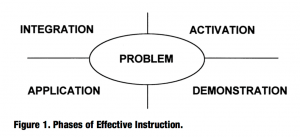
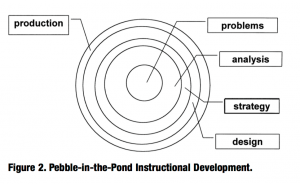
It is interesting here, to think about the comparisons and differences between game design and lesson development, therefore. With good lesson design, we typically are not changing our knowledge fundamentally as we are developing our content, activities, and instructional plan after setting our end goal. If we know our goal is to have the students understand simple machines through an activity that involves building racecars out of popsicle sticks and rubber bands, we know as we design the lesson that we will not understand Popsicle sticks much differently at the end of our process than when we started. This is very different in game design, where the platform that we develop our content in will become easier to use, better understood to apply, and potentially evolve as we work on our design. There is also the time frame involved. In lessons, we typically design over a few days, although there is iterative design that occurs year by year as we go back and revise and improve lessons we’ve used in the past. For game design, the period of development which may be months or over a year, almost guarantees that changes in our understanding of the platform, or the platform itself will happen. Yet, there is a common idea here — the start (think Gagne’s first event: Gain Attention) and the end (culminating activity) both need to be powerful to best ensure their success.

Regarding prototyping: “observe how easily they manage to pick up the controls and mechanics. It is much simpler to make a game harder than to make it easier.” (Page 290)

“As you work on a project, you’re likely to become overly familiar with some of the content you have created, and familiarity can breed contempt.” (Page 291)

“Always try to remember how you first felt when you play a level or tried to pull off a particular move” (page 291)

Regarding the role of programmer versus designer — assuming that you have a team working on the project: “nevertheless, a designer who cannot program will be beholden to the talents and inclinations of her programmers, which can be eternally frustrating.” (Page 292)

Although not all of these ideas apply directly to instructional design outside of gaming, or certainly a few ideas in here that are significant whether we are looking at games, educational games, or just classroom instructional practice. A few thoughts that came into my mind through the reading:

One of the emerging technologies that still are in their early stages are virtual worlds. Specifically, second life is a platform that has no content at a starting point, but gives developers ample opportunity to construct openly in their environment. Is Second life is a technology looking for a story? There are certainly examples of projects that are creating virtual worlds with a story embedded — World of Warcraft, Runescape (quote of the day from my seven-year-old this morning “dad — someone ‘jacked’ my identity — can I make a new one?” I had to ask him what that meant, and then realized identity hijacking was a fairly common phenomena in that virtual world). These MMORPG (Massive Multi-player Online Role Playing Games) have story built into them, and a social community as a significant element. The numbers involved in these worlds attest to their viability, and as informal learning environments, we can use that as a learning laboratory to best design from.

Regarding multi-touch interfaces, I’m usually most intrigued with iPhone, but I saw this video recently that provided another window in game design: Microsoft surface D&D project

So here is a example of a powerful multi-touch technology, where the game play, the story, and the technology all Weave together. Perhaps that is the best view of where the future lies in game design — a happy mix of all three.

Next Page »